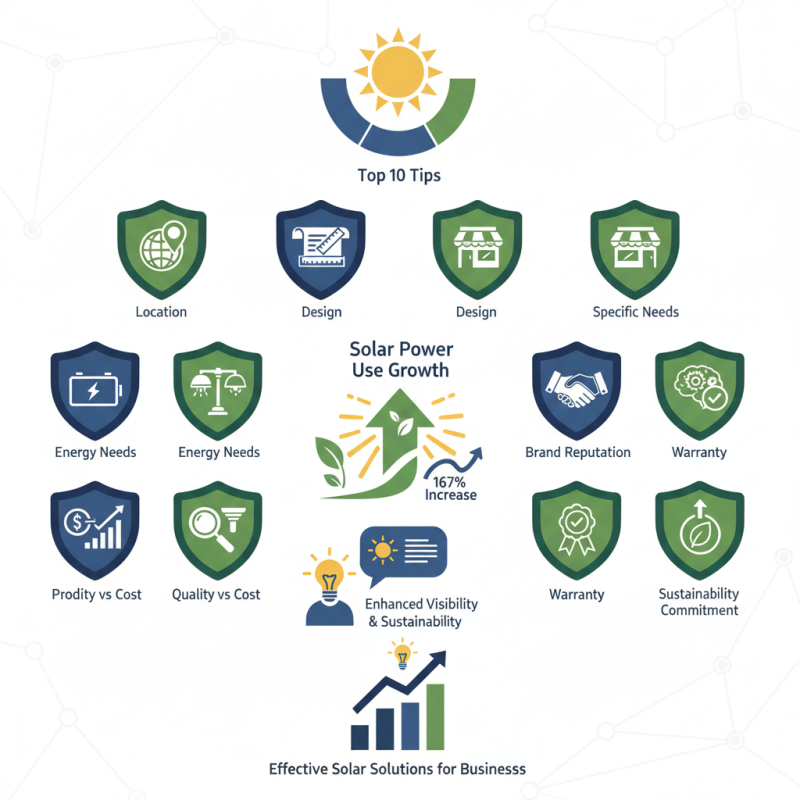
When considering how to choose solar lighting for commercial use, businesses must navigate an evolving market. According to the Solar Energy Industries Association (SEIA), solar power use has grown by over 167% in the last five years. This rise emphasizes the importance of effective solar solutions for businesses. Expert Robert Green, a prominent advocate for renewable energy, states, "Investing in solar lighting not only enhances visibility but also contributes to sustainability."
Choosing the right solar lighting system involves understanding various factors. Location, design, and energy needs are crucial. Solar products vary widely, and not all options are suitable for every business. A common mistake is opting for the cheapest solution without considering quality or efficiency. Despite the initial savings, inferior products can lead to higher long-term costs.
Moreover, businesses should reflect on their specific needs. For example, a retail company might require different lighting compared to an industrial site. Quality, brand reputation, and warranty terms are vital in ensuring a sound investment. Ultimately, selecting the right solar lighting requires careful evaluation and a commitment to sustainable practice.
Solar lighting offers numerous benefits for businesses looking to enhance sustainability and reduce costs. According to the U.S. Department of Energy, using solar energy can cut electricity bills by up to 75%. This significant reduction allows for reallocation of resources to other crucial areas. Moreover, solar lights require minimal maintenance, contributing to long-term savings.
Choosing solar lighting for your business can also improve your brand’s image. A study from the Solar Energy Industries Association highlights that 78% of consumers prefer companies with sustainable practices. Such choices not only align with eco-conscious values but may also attract more customers.
Tip: Evaluate the location before installation. Ensure solar panels receive adequate sunlight throughout the day. Also, consider including motion sensors for energy efficiency. Select fixtures that are durable enough to withstand local weather conditions. This attention to detail can maximize the benefits of solar lighting.
However, there might be installation challenges. Some businesses may face difficulties securing permits or arranging financing for solar projects. Therefore, it's important to conduct thorough research and engage with experts. Proper planning can mitigate these issues.
| Tip Number | Tip | Benefit | Considerations |
|---|---|---|---|
| 1 | Assess Your Lighting Needs | Ensures adequate illumination | Different areas may require different light levels |
| 2 | Choose Energy-Efficient Models | Reduces energy costs | Look for high lumen output with low wattage |
| 3 | Check Solar Panel Efficiency | Maximizes energy collection | Higher efficiency panels can be more expensive |
| 4 | Consider Installation Type | Affects cost and complexity | Decide between fixed or adjustable fixtures |
| 5 | Choose Durable Materials | Increases product lifespan | Materials should withstand local weather conditions |
| 6 | Evaluate Battery Life | Ensures consistent performance | Longer battery life may incur higher costs |
| 7 | Look for Smart Features | Enhances convenience and control | May require a smartphone or app |
| 8 | Consider Aesthetics | Maintains brand image | Choose designs that match your business style |
| 9 | Research Warranty Options | Protects investment | Longer warranties can indicate better quality |
| 10 | Review Customer Feedback | Informs purchasing decisions | Look for reviews on performance and reliability |
: Solar lighting can reduce electricity bills by up to 75%. It also minimizes maintenance costs.
Businesses using solar lighting often appeal to eco-conscious consumers, improving their brand's image.
Evaluate sunlight exposure and consider adding motion sensors. Durable fixtures are essential for local weather.
Options include pathway lights, flood lights, and decorative fixtures, each serving different purposes.
High-quality solar lights can convert up to 20% of sunlight into usable energy, lowering energy costs.
Securing permits or financing for solar projects can be difficult. Conduct thorough research beforehand.
Look for robust materials with good weatherproof ratings. Products should ideally last at least 10 years.
Over 70% of businesses prioritize security in lighting, so choosing effective solutions is crucial.
Installation and maintenance challenges can arise. Reflecting on these can guide better decision-making.
A better return on investment is possible with efficient options that require less upkeep over time.
Choosing solar lighting for commercial use involves understanding its numerous benefits, such as reduced energy costs and minimal environmental impact. Businesses should start by evaluating the different types of solar lighting solutions available, including streetlights, bollards, and wall-mounted options. Each type serves specific needs, so identifying the right fit for your business is crucial.
Next, it's important to assess the energy efficiency of these solar options, as higher efficiency translates to more savings over time. Cost-effectiveness is another vital consideration; initial installation costs should be weighed against long-term savings. Lastly, understanding regulatory standards and potential incentives can help businesses maximize their investment. By following these steps, stakeholders can effectively learn how to choose solar lighting for commercial use that meets both their operational needs and sustainability goals.

 GKE Power